Adam's Choice
The way to be truly good is to choose to NOT do what is bad

There once lived a man named Adam who lived happily with his wife, Evelyn, and their daughter, Sadie. Adam liked to tinker, and over the decades he invented some interesting and useful machines that made life in their hometown of Eaton, Texas, less burdensome. The residents of Eaton were so grateful for Adam’s ingenuity that they held him in high esteem and trust. For many years the town of Eaton was a happy place to live for Adam and his family. Until the day a bad thing happened.
On that day Sadie was diagnosed at age eleven with a rare and incurable form of brain cancer. Adam and Evelyn could only watch Sadie grow weaker and weaker as she slowly died. For Adam the thought of his innocent child suffering, the thought of his inability to cure her, the thought of the injustice of her death plunged him into a deep depression for a very long time. He neglected himself and everyone around him. The town’s pastor led his congregation to pray daily for Adam’s deliverance. Believing he had failed Sadie, Adam concluded that he deserved to be unhappy. “Nothing good will ever come my way again,” he thought. Evelyn grew gravely concerned, but neither she nor anyone could pull Adam out of his despair. Until one day, Adam decided to tinker once again in his garage.
Adam worked tirelessly, rarely stopping to eat or sleep. Nearly a month passed before he emerged with an expression of satisfaction.
“I believe I’ve done it!” he declared to Evelyn. “No one in Eaton will ever suffer from bad things again!”
To everyone’s amazement Adam had invented a machine that sucked up all the bad things that might happen to anyone in the town. He invented a machine that removed any chance that the cruelty of life could cause anyone else in Eaton to suffer like he did, or to suffer like he believed Sadie did.
For a while this made the town of Eaton an even more delightful place to live. People were always kind to each other. Everyone always obeyed the law. No one ever became sick. The days were always sunny. Eaton was a paradise! And because none of the residents of Eaton lived in fear of anything, regular attendance at church began to wane to the quiet chagrin of the pastor. The town put their faith into Adam and elected him Mayor of Eaton.
Not long after Adam’s machine turned the town of Eaton into heaven, the consequences of the machine became evident. At first there were little things, like Eaton’s ice cream shop changing from 31 Flavors to 1 Single Flavor, or the physical inability to move your car across the town’s only traffic light at 2 a.m. when the light was stuck on red (which it was known to do from time to time of its own accord).
Little things like this began to wear on the townspeople but not Adam. Adam was blissfully delighted in his peace of mind which gave him a childlike confidence that everything would work out just fine. There was no other way it could be. There was no other choice. The machine removed any opportunity for life to be anything but predictable. Over time this slowly frustrated the townspeople who became tired of vanilla ice cream or abandoning their car at the traffic light to walk home at 2 a.m. Even Evelyn was thwarted from throwing Adam a surprise 40th birthday party because Adam’s machine made lying impossible.
Soon the residents of Eaton grew to regret the trust they placed in Adam. They pleaded with him to shut off his machine.
Adam denied them saying, “Peaceful, blissful living can only be accomplished by removing any chance of making the wrong choices in life.”
“What is a wrong choice?” Evelyn asked Adam.
“Any choice that causes suffering!” Adam responded.
“Who gets to decide that?” she asked.
“The machine knows.”
And that was final.
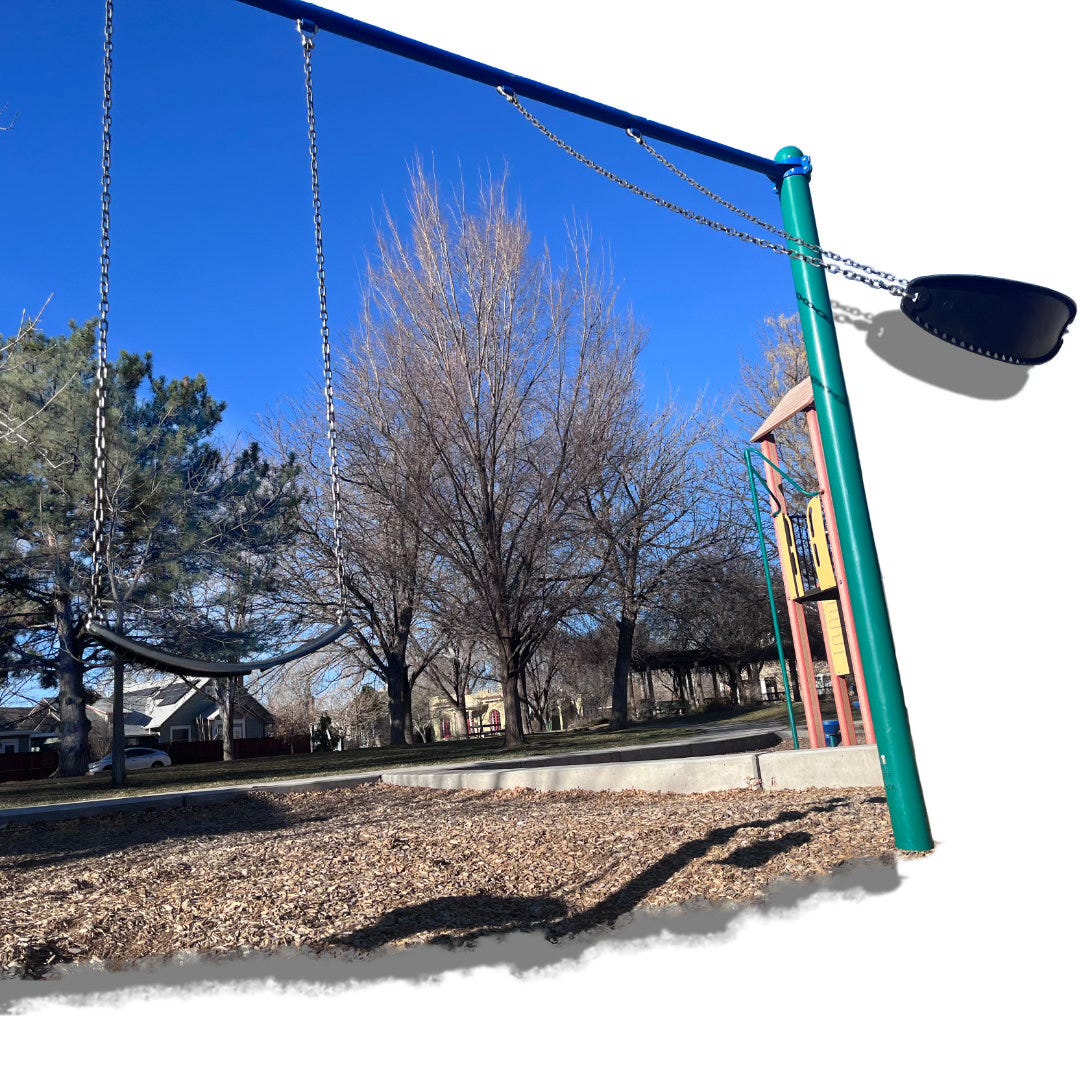
About this same time Adam began noticing something peculiar. He developed a constant, nagging feeling that someone was always behind him, watching. He would turn around suddenly trying to discover who was lurking there only to find no one. Nothing. At first Adam shrugged it off, but as time went on that disregard turned to dread. “How could this be possible?” he thought, as he tweaked the settings on the machine without success. On the verge of madness, he plopped himself down on a bench in the town’s park near the children’s playground. He remembered how he would bring little Sadie here and push her on the swings. He bent forward, put his elbows on his knees, and rested his head in his hands. “The machine is failing,” he thought. “It’s not supposed to allow this type of doubt.” That’s when he felt it again. Someone watching him. He picked up his head and saw a young girl happily swinging on the swings. “Where did she come from?” Adam thought, as he tried to identify her through the blur of her motion. She looked back at Adam and slowed her swing allowing him to see her full face.
“Sadie!” shouted Adam. He bolted from his bench and ran to the set of swings.
“Hi Daddy,” the girl said as her motion slowed.
“What!? I don’t understand! How can you…,”
“Don’t try to think too hard about it,” she said.
“How did you… What are you doing here?” Adam asked.
She sighed and said, “I can see you are sad, Daddy.”
“Yes, I was. But I made that all go away.”
“Your machine.”
“Do you like it?” Adam asked.
The girl smiled at him and remained silent for what seemed like a long time. Then she said, “The townspeople are suffering.”
“That’s not possible! The machine is designed to take all the bad things away. Only good things are possible now. There is nothing to fear.” He sat down in the swing next to her.
She swayed in her seat contemplating something and then asked, “Without the bad how do you know what is good?”
“I don’t understand what you mean. Good doesn’t cause suffering.”
“So, suffering is bad. That’s why you made your machine?”
“Right!”
She gave that some deep consideration for a moment before asking, “What if I want to know what suffering feels like? If I can’t choose to experience suffering, is that good?”
“Why would you want to suffer?”
“Maybe to help me value and appreciate not suffering,” she said, then, with a shrug added, “How do I know what cold is if I can’t experience hot?”
Adam looked away unable to respond. Then he turned to her and said, “Are you for real?”
She smiled and said, “Does it matter?”
“Yes! It means that you chose to come back!”
“Yes, I did choose to come back,” she said, then paused. “I didn’t have to, though.”
“But you did choose to come back to me!”
“Does your awareness that I could have chosen differently make my choice to be here with you more precious?”
“Yes! It does.” Adam admitted with a bit of wonderment. Then, after a long pause he added, “If you had no other choice, then your presence here would be involuntary. But it wasn’t! You wanted to come here!” He felt a joy expand in his heart. A joy that felt so much more real than the artificial bliss generated by the machine.
She smiled and started swinging again. Adam let out a slightly giddy laugh and started swinging along with her. They swung higher and higher, faster and faster. The playground was a blur in Adam’s vision, but he heard her laugh joyfully. It took a moment for Adam to realize that the other swing was slowing down. Then, another moment to realize that he was alone. When he brought his swing to a stop, his first emotion was the old familiar sadness which was bitter compared to the joy he had just felt. Then, a thought came to him from somewhere, “This old sadness has helped me value and appreciate real happiness.” He preferred this happiness so much more than what his machine created.
“My machine!” he thought. He now understood how his invention caused the townspeople to suffer. He realized that his machine had forced them into compulsory choices by stripping away the option to do anything other than what the machine deemed good. Then he said out loud, “Evelyn was right! The machine must be stopped.”
Adam quickly walked home with a new determination. He passed a neighbor who was building a new deck along the front porch of his house. Adam waved cheerfully, but the neighbor only grunted dismissively and continued hammering nails into the wood decking. Adam turned and entered his own garage. There he unceremoniously shut down his machine. As the machine wound down to silence, Adam sensed a hush as if the entire town was collectively holding its breath. The only sound was his neighbor’s hammering followed by a dull thud.
“Ouch!” the neighbor exclaimed, as he dropped his hammer and staggered across his new deck tightly holding his thumb in pain. That was the first sign that life in Eaton, Texas, was on its way back to the normal randomness that came from the natural counterbalance of free will.